
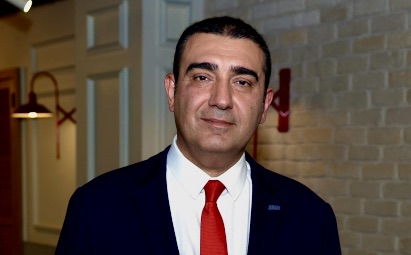
We expanded globally with Turkish Airlines and now serve 60 airlines.
SEM Plastik proudly represents Turkey by manufacturing catering equipment and kitchenware for Turkish Airlines, Pegasus, and over 60 airlines worldwide.
Source : haber.aero , 21/08/2024
SEM Plastik is proudly representing Turkey on a global scale by manufacturing food service equipment and kitchenware for Turkish Airlines, Pegasus, and over 60 airlines around the world. The Chairman of the Board, Yavuz Eroğlu, shared this success story and innovations in the aviation sector with Haber Aero.
It supplies products to 7 major airlines listed among the world’s top 10, thus successfully representing Turkey in this niche segment of the aviation industry. Meal service equipment, ancillary items used during catering, and prep containers for aircraft galleys are produced in Turkey and exported globally. These are all made by a Turkish company. In recent years, Sem Plastik has achieved notable success in this field. We spoke with Yavuz Eroğlu about this success story and the lesser-known side of aviation. Eroğlu is also the President of the Turkish Plastics Industrialists’ Research, Development, and Education Foundation (PAGEV), and he explained this intriguing area of aviation and the developments in it to Haber Aero.
Opening Up to the World Alongside Turkish Airlines
Aviation is a highly specialized sector. Flying itself is extraordinary — and during a flight you’re inside a cabin with a different pressure setting. To ensure flight safety, there are unique standards and specialized instruments under strict certification. Amidst all of this safety apparatus, you travel from one point to another, and you’re offered various in‑flight services. These services and amenities inside the cabin are designed to make your journey more pleasant. At such heights, the instruments and equipment you use must carry features that match those conditions. In addition to safety, every detail must be considered to provide an environment where passengers enjoy what they eat and use. That’s where the technical challenges of product design arise. It doesn’t matter which material you use — metal, plastic, aluminum — you must be a supplier who deeply understands aviation’s special requirements, whose technology is well built, whose infrastructure is robust, and whose personnel have the necessary expertise. That’s exactly what we emphasize the most. With 40 years of aviation experience, today the number of airline clients we serve has exceeded 60, and they’re all major carriers. Our flag carrier, Turkish Airlines, stands at the forefront. We opened up to the world together with Turkish Airlines. So there are many stories behind experience and the requirements demanded in product quality. Over these 40 years, passenger expectations have also evolved. We must produce in harmony with that change in expectations and experience.
The Most Important Trend: Sustainability
There are significant trends in the aviation industry. Over the past decade, the most important trend has been sustainability. Airlines exert tremendous effort to minimize their carbon emissions. Some of this is relatively straightforward to implement. In aviation, most emissions are tied to jet fuel — in fact, that number reaches up to 90%. The other part is sustainability in the products we manufacture. The biggest change in the past 10 years has been in sustainability. After sustainability, the second priority is design — eco‑design. Products must be designed from the outset according to sustainable principles. So in the last decade, sustainability and design have become focal points in our work.
Our Signature on Unique Products via Turkish Engineers
From the moment you board the aircraft, all the equipment used to serve meals comes from our product range. The containers in which food is prepared, the ancillary tools used during service, and the prep containers you never see in the aircraft galley are our core products. We serve many airlines worldwide. First, we design according to each airline’s brand identity. That is crucial because the design sets the main concept. How an airline wants to communicate with passengers in economy class, business class, or comfort class — what they wish to convey — we realize that. We have an excellent design team. We present 3D designs and VR simulations before converting them into physical products. Based on a brief from the airline, we design all of these products. We build the airline’s brand concept into the passenger experience. Subsequently, we certify them in terms of sustainability so that in the airline’s annual sustainability report, they can include environmental impact and emissions reduction metrics. Our product range is very broad. When you board a plane, if you turn over many products, you’ll see our brand. As a firm producing through Turkish engineers, it’s very gratifying that we now wave our flag in 60 countries.
One of the Top 5 in the World in This Field
We have 40 years of experience. Bringing our products to airlines all over the world, showcasing our quality and service philosophy — that is the main reason for our success. In terms of competitiveness, our company is now the fifth largest producer and supplier of this kind of product worldwide. Among those five, if you count only those who manufacture (not just design), we rank in the top three. What sets us apart is that we design, produce, and sell the products ourselves. Over these 40 years, the knowledge we have amassed and the feedback from our clients, which we have used to continuously improve our products, has been very influential. Among the 60 airline and catering companies we supply, some purchase through catering firms, others procure directly. Geographically, these 60 airlines span from Singapore to North America — we’re suppliers to many prestigious airlines globally.
We Produced Flame‑Resistant Plates for THY and Pegasus
Clients approach us specifically asking for reusable products rather than single‑use ones. We design, develop, and manufacture such products. One such product is our flame‑resistant plate. It’s unique: it can go in an oven, food can be prepared at 230°C inside it, it must not melt, it must be food‑safe, it’s served to the passenger, then washed and reused. Compared to porcelain, it’s lightweight so that less jet fuel is consumed and carbon emissions are reduced — providing a positive contribution to the airline’s environmental goals. When we first created this in the world, only three companies were making such plates. This plate must mimic porcelain, yet be much lighter to reduce emissions. After many years of research, we developed it. Today, this product is used in all classes (including economy) on our flag carrier. We also incorporate special boron materials on the surface to reduce scratching from forks and knives, thereby extending its useful life. This product has won awards globally and in Turkey — including the Sustainability Academy Prize for our flame‑resistant plate. What fulfills us most is that it’s reusable and that it helps reduce an aircraft’s carbon emissions. First implemented in Turkish Airlines, then in Pegasus, we now manufacture and export it to many countries and present it as a product that adds value to passengers’ in‑flight experience.
All Our Products Are Recyclable
Sustainability has several dimensions. One is that the products airlines demand must be recyclable. That is a basic requirement: any product in aviation must be designed and offered with recyclability in mind. All our products are recyclable — but there is another level. That is using materials not from raw fossil sources, but from recycled ones. And above that is the ultimate: a closed‑loop recycling system. For example, if a PET bottle becomes waste, is collected, recycled, and transformed back into another PET bottle — that is high value.
We Recycle Food Trays Back Into New Trays
In apparel, that closed-loop idea doesn’t quite apply. Here, the goal is for the product to return to itself. In aviation, for example with Pegasus Airlines: the meal trays we supply are used multiple times. This is great — but when their service life ends, we collect them, recycle them, and remake new trays from them. So the tray you see might once have been another tray, and when its service life expired, it was renewed and reincorporated into production. These closed‑loop systems are services we offer to customers around the world, helping reduce their emission footprint and support their sustainability goals. This year, the product we made with Pegasus even won a Recycling Award. That underscores both our and our valued client’s contributions to sustainability goals. As we do this in Turkey — which is easier — consider that we supply products to 60 countries. If a foreign airline uses them, the expired units must be collected, potentially disassembled on site, then shipped back in smaller volume to be recycled — because bringing them back as is would have huge logistics costs. So we build systems per country to break them down locally and send material back to Turkey. These are among the most complex issues we’re working on in aviation for sustainability. Through these services, we support aviation clients worldwide and their sustainability targets. We produce catering materials for THY, contributing to our country’s economy.
Design Was Turkey’s Biggest Past Deficit!
One of our strongest sides is our design department. In previous years, design was Turkey’s biggest weakness — a major loss of value added. Turkish companies produced excellently, and we could be a global manufacturing hub, but design was done elsewhere. That designer would pitch to an airline, manufacture it, then sell it at higher prices. We recognized this and developed our design department so that more value remains in Turkey. Now our design is very strong: concept, prototyping, VR visualization, producing samples, and presenting to clients — we’ve built an infrastructure that can support the full concept. We offer this infrastructure worldwide, proudly.
We Compete with China Through Design Advantage
Our advantage is that many competitors don’t produce themselves — they do the design and outsource the production to China. But the Chinese firm can’t sell directly; they go through the designer, who then sells at inflated prices. Since we both design and produce, we offer our products to market with differences in cost that aren't huge compared to China. Another advantage is Turkey’s geographical proximity to Europe. Most green transformation legislation originates in the EU, so being close helps. Because we adapt quickly to green transition policies, we can lead airlines. That proximity and capacity help explain why we serve 60 airlines.
THY Used to Buy Products from Abroad at High Cost
I must mention the late Turgut Özal. He brought Cem Kozlu into the THY board, planning to develop Turkey’s private sector. In telecom, we would build national infrastructure. Back then our big clients included Teletaş and Netaş. We were producing "difficult parts" for telecom. Therefore, we already had significant technical expertise. THY used to buy cups from abroad at high cost and sought alternatives. We asked: could we localize this? Can we produce locally more affordably and sustainably? That quest led them to us. We handled increasingly complex parts, and soon achieved quality beyond European standards. That allowed us to open up to the world.
We Need State Support for Our Companies
For national development, especially large companies that interact with the state, pathways must be opened. That’s not just in Turkey — globally, many big firms grew with governmental backing, enabling them to scale. If we aim to build firms of global scale, we must first open doors domestically. All large successful firms have had solid state support. Without it, you remain dependent on foreign sources. The dangers of dependency are clear — especially in crises like the pandemic, when supply chains broke and prices skyrocketed. That’s when we realized how critical production is. We adopt strategies to bolster Turkish firms rather than rely abroad. THY plays a special role in our aviation development. Today, 90% of in‑flight products are local. Achieving that 90% results from steps taken in earlier decades. Our exports to many countries bring value to Turkey and support the national economy. I thank past and current leaders for those decisions and for extending those policies over 40 years.
Training 2,000 Students in Our Field
I also serve as President of PAGEV. The name itself includes Research, Development, and Education — and we have our own schools. In Turkey, we train technicians for recycling and the plastic industry. Starting at our own building, we support public education, help equip workshops, and more. We currently have 2,000 students engaged — truly serving the future of Turkey’s recycling and sustainable plastic industry. For me, it’s an honor to hold this role. Research and education go hand in hand. The knowledge gathered benefits not only our company, but the entire industry. Contributions in sustainable practices, lightweighting, reducing carbon emissions, bioplastics, recycled materials, different structures — all come from these R&D and education efforts. We strive to spread this knowledge beyond our firm, through the foundation and across companies. We also track global knowledge. Especially now, sustainability has become critical in Turkey. Looking at the medium‑term plan, green transformation and digital transformation dominate. Green transformation is a major opportunity for Turkey. Because we missed the earlier industrial revolution timing, we now aim to align with the green revolution. Through timely action, correct policies, firm support, and proactive companies, we can make great strides. To further that cause, I also serve on the board of a European plastics industry NGO in Brussels — staying close to those processes. We also founded a new NGO, PAGÇEV (Green Transformation & Technology Association). This association lies at the core of these sustainability processes: disseminating knowledge in Turkey, fostering correct dialogue with public authorities, helping shape decisions. The 60‑country export story of our products is rich — but this green transformation journey must propel it further. If we fail, green transformation becomes a green barrier. Given that the EU is Turkey’s largest export partner (50% of exports), we must actively collaborate with EU markets in this transition. Otherwise, it becomes a risk to our economy.
A Cup That Killed Foam Early Gave Us Trouble!
I go back 30 years. We localized a product. THY complained: “some of these cups warped when filled with hot liquid.” We were amazed — all had been tested under conditions identical to airline tests. One such cup came from Malatya. We reviewed test results — all positive. Why would this happen? We realized it’s tied to altitude: Malatya is at a higher elevation than Istanbul. In Istanbul, water boils at 100 °C; in Malatya maybe 90–95 °C. So the test conditions varied. Once we grasped this, we designed a different cup for ground services. We adjusted its temperature tolerance. Here’s another example from 15 years ago: we had secured a contract with Singapore Airlines. We were thrilled — it’s a premium airline. The first shipments arrived perfectly. A week later, a passenger complaint: “the foam on the beer in your cups disappeared too quickly.” Our quality team tested side by side with the competitor’s cups. Their beer foam lasted longer. No difference in chemicals or materials — what then? Foam. Another complaint came: a Muslim passenger was given what was supposed to be apple juice — but foam had collapsed and it was mistaken for beer. That disconcerted us. We consulted Evyap, a domestic firm familiar with foam chemistry. They explained it was surface tension. The foam touching the cup wall collapses, like dominoes. If you can adjust the cup’s rim angle, you can fix it. Even though the products looked identical, a tiny angle change would solve it. We did just that. We slightly altered the angle beyond what our competitor used. We told the client: “our foam lasts longer.” They confirmed, and the business returned to us. Thankfully the client was satisfied. That’s how we overcame that challenge.

For more detailed information, click here: https://haber.aero/ozel-roportajlar/yavuz-eroglu-thyyle-dunyaya-acildik-60-havayoluna-hizmet-veriyoruz/