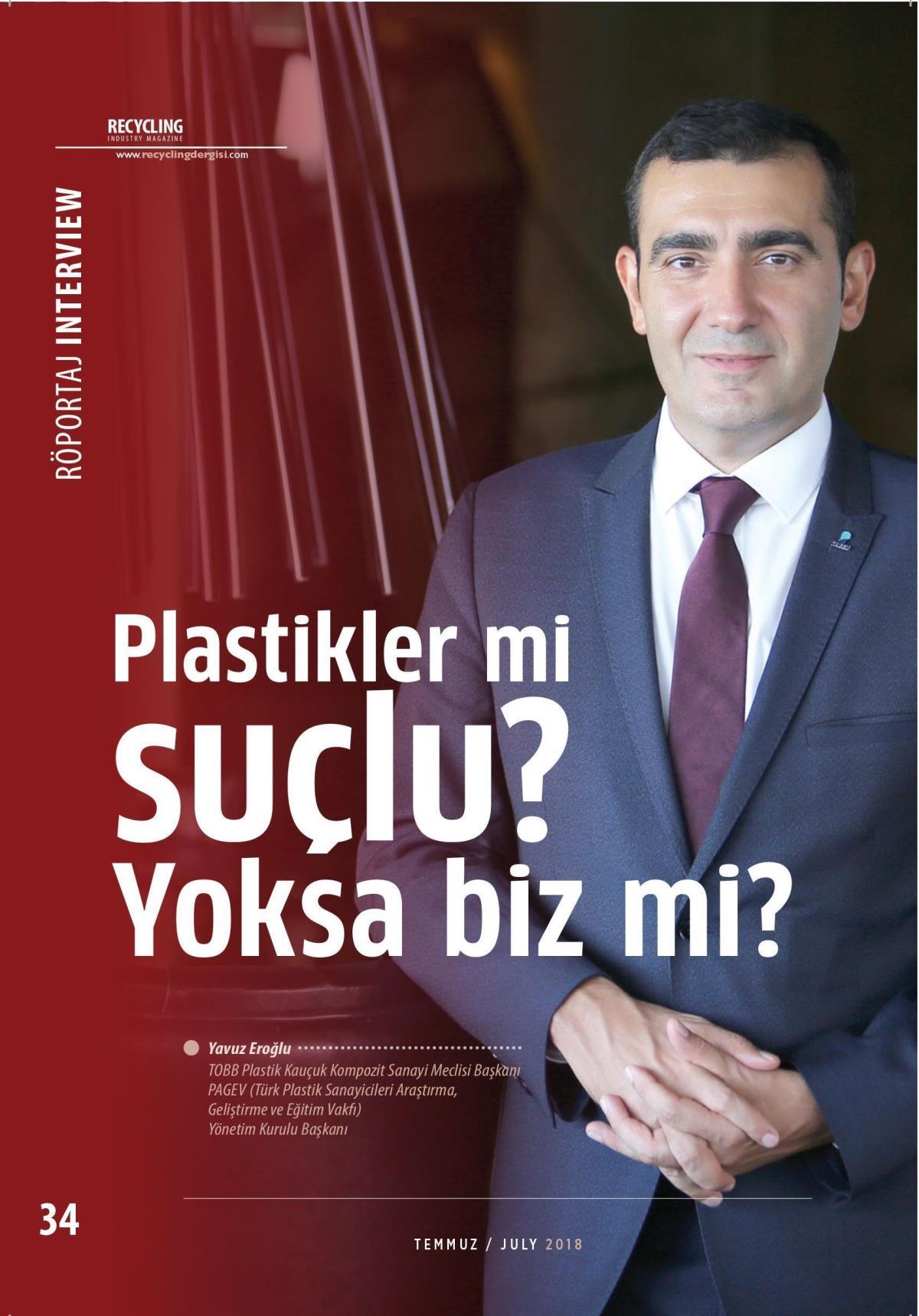
Chairman and General Manager Yavuz Eroğlu's Recycling industry magazine 130. the interview in which he shared his views on plastic in the issue;
"RECYCLABLE PLASTICS HAVE THE CHANCE TO REUSE" IS IT PLASTICS, OR IS IT US?
1 - considering the place and importance of plastic in our lives, can it be considered that human beings give up the plastic completely and replace it with another product?
Plastics are the indispensable material of the future in place of materials such as glass, metal, rubber, wood, inorganic materials all over the world, or in combination with these materials. Plastics are the main input material of many sectors, from food to health, construction to automotive, cosmetics to textiles.
Plastic materials, which rapidly increases its share in the global economy, offer significant advantages compared to its alternatives. Plastics, which are much more economical and easy to apply, have opportunities in terms of logistics.
The raw material of plastics is the waste part of oil. The most valuable parts of oil are considered automotive, aerospace and energy fuel. Only 4 percent of the oil is produced from the most worthless part (NAFTA) plastic. So plastic can be used to evaluate the part of the oil can not be said. It is also possible to recycle 4 percent of the economy again. Every barrel used to make plastic materials means carbon dioxide, which is not released into the atmosphere, which is extremely important for the environment.plastics offer significant advantages not only during production but also during use and recycling. For example, the energy required to recycle glass bottles is 66 percent of the original production energy and the energy cost of recycling in plastic materials is only 10 percent of the original energy cost. Plastics are recycled between 120 and 200 degrees, while other alternative materials are recycled between 650 and 1400 degrees. All recyclable plastics contribute to the social and economic development of countries by creating a great chain of added value.
20. accepted as one of the greatest inventions of the century, plastic has spread from Europe to the world at a short time. Although it was a new material, it replaced materials such as metal, wood and glass. Easy shape space, accessible, lightweight and functional use of plastic has enabled the choice. Over time, it has diversified into a new set of features. Plastic will continue to be in our lives unless you can replace a material that makes people so much easier. So it's not possible to give up the plastic completely. Besides, plastic sector is a new and constantly developing sector with new technologies. Bioplastics are a good example.
2-Why is plastic the first waste that comes to mind when it is called environmental pollution?
Unfortunately, the effort to create a false perception of plastics has been going on for years. People who can not refuse the advantages of plastic materials are carrying out a smear campaign about plastic materials on the grounds that it is harmful to the environment. Most of the time, these evaluations are unscientific and do not correspond to reality.
Today we see that the giant industries that produce plastics are taking place. For example, the Turkish plastic sector, many small and medium-sized companies, including some 11 thousand manufacturer companies are operating. The plastic sector, which offers cheap alternatives to the public, is growing more and more day by day. Unfortunately, the representatives of the competing sectors who are disturbed by this situation play an active role in the smear campaigns of plastic materials.
The people who leave the environment to nature, not plastics, pollute. At this point, it is necessary to create the awareness necessary to protect the environment in the society and to create the habit of use-convert-use by changing the habits of use-at.
3 - is the Prohibition of the use of PET bottles and plastic bags a solution?
Prohibition has not been found to be a solution to any problems. Besides, it is a wrong approach to see PET bottles and plastic bags use as a problem. Because if plastics were a threat, the world-famous brands would not prefer plastic packaging for their products. As long as there is no material that is more economical, light and easily convertible than plastic, it will protect it by strengthening its position in our lives.
Underlining that the main thing is not banning is to promote recycling. First of all, it is necessary to create a public awareness of recycling and to facilitate recycling for people. Increasing infrastructure investments in this area is essential. Especially local governments play a critical role at this point.
As a result, it is not a solution to bring ban on the wrong use is damaging. If we start off with prohibitions, let's say that children can be electrocuted, or let's ban the electricity in the house, or let's ban the bike, saying it's hard to maintain the balance.
4 - where is the contaminant and destructive effect of plastics on nature in all waste groups?
It is clear that all the wastes left to nature are harmful to the environment. Plastic, glass, paper or metal does not matter where the waste is not nature is recycling centers. In order to prevent waste of Natural Resources and to cope with the energy crises that may arise, recycling and reuse of waste must be required.
Plastic recycling is the most environmentally friendly material. In addition, it is possible to recycle plastics infinitely and easily... if we look at the recovery of recycled plastics, it is obtained from 8 recycled plastic bottles into 1 form. If a 2.5-liter plastic bottle is recovered, it can save 6 hours of 60 watts of electricity. A sleeping bag can be made from 35 2.5 liter PET bottles.
Plastic and its alternatives are recycled as a result of the most contribution to the environment is seen by plastics. For example;
✔ from 1 ton plastic recycling, 5,774 kWh of energy, 23 cubic meters of storage area and 2,593 liters of oil is saved.
✔ 1 ton glass waste recycling saves 100 liters of oil.
✔ recycling of 1 ton tire waste saves 95 percent of energy.
✔ if half of World paper consumption is recovered, 8 million hectares of forest can be protected each year.
✔ when aluminum waste is recycled, pollutant flue gas emissions are 99 percent reduced.
✔ it is possible to prevent cutting of 17 trees by recycling 1 ton paper/carton waste.
As a result, it is important to dispose of waste without damaging the environment. Thus, waste can be prevented from threatening the environment and human health. For this, we need a functional ‘waste management’ application. At this point, the necessary infrastructure and incentive mechanisms need to be activated.
5 - the European Union has prepared a bill to prohibit the production of disposable plastic products with the aim of protecting nature and marine life. Can this ban be applied? What is the effect of plastic industry if applied?
This bill is a symbolic attack on a well-defined category of products, but also contains definitions that do not conform to the industry classification of disposable products. They're confusing the consumer's mind. What do you mean by disposable? Once you understand this very well. A plate used once can be used several times when it is a bit thick. What is the measure of this and who will determine it, who will supervise the questions to ask.
The main purpose of the bill is said to be plastic waste in the sea, but 80 percent of the waste in the sea originates from land. That is, countries do not invest in waste management and garbage collection infrastructure. Therefore, the solution of the problem is to create a waste infrastructure that is installed and managed correctly. The solution is to prevent and recycle wastes from reaching the sea. We believe that we need to understand why plastic products are used. The emergence of disposable plastics was primarily the elimination and reduction of infectious diseases in places where mass consumption was made. As a matter of fact, they were very successful in facilitating life. As a more economical product, they have contributed positively to the lives of many people. The main problem here is that these products are recycled properly. The only thing that is needed for this is that municipalities and public authorities create a properly functioning waste management system. This is a very simple process, so there are recycling boxes that we can parse and dispose of the products we use and they are passed on to the recyclers. However, instead of making this investment, we do not find an unequivocal approach right. Plastic waste problem in the sea can not be solved with superficial and populist approaches.
The main issue we are talking about today in the EU Commission is the use of oil resources by using recycled raw materials in plastic products. The goals in this direction are discussed and it is a contradiction to ban these products when they are said to increase the use of recycled plastics. The aim here is to legislate this bill before the EU parliamentary elections in May 2019. Another goal is to create a market to sell the biopolitical raw materials developed by several of the EU's leading countries, including Germany. After the bill becomes law, the member states will be given two years of time to implement the directive. Since the bill is unacceptable in this way, we will seek ways to make a legal objection to the single-use plastic definition by collaborating with relevant stakeholders and policy bodies in the EU.
6 - Can countries reduce the amount of waste plastic left to nature by such prohibitions?
Prohibition is not a solution ... the system that consciously consumes plastics and recycles when we set up the actual solution ulaşmıştığımızla. If you cannot deal with the waste problem, you are prohibited from investing in a well-functioning waste management system. This approach is also under the Prohibition decisions of countries such as India, Bangladesh, Kenya. We don't find this approach true and realistic. Plastic is a product that corresponds to the life of people, so there is a need. An advantageous material that provides convenience in many respects. According to their alternatives, we are talking about a more environmentalist material from production to recycling. You can't replace it better. When you ignore this fact and forbid it, you are getting away from producing solutions. The problem is becoming much more complex and diversified. Besides, plastic material technology is moving too fast. The plastics industry has reached the power to design brand new and groundbreaking products for humanity.
7 - can plastic waste be collected and re-evaluated as an intermediate product? What are the studies in this direction in the world?
Plastic is a very useful and useful material when used correctly and when recycled. In this direction, recycling is one of our important agenda items. Together with pagçev, which continues its activities as an authorized Organization for packaging waste in Turkey, we carry out projects on Environment and recycling, provide trainings and try to raise public awareness. We are carrying out a recycling organization throughout Turkey.
PAGCHEV, founded in 2014, collected 220 thousand tons of waste in 2017 with an increase of 22.2 percent compared to the previous year and recycled 12 million tons of waste. The contribution of the wastes collected by pagchev to the economy reached 610 million TL.
Finishing the recycling chain of packaging waste consisting of paper, cardboard, wood, composite, glass and metals together with plastics, Pagchev created plastic products that reached 89 thousand 600 tons in the first place among the wastes collected last year. The second place included paper and cardboard products, while the rest created glass, metal, composite and wood. 1.5 million trees have been rescued by the amount of waste that pagchev has transformed. With recycled plastic waste, 7,1 million kilowatt electricity, 2,1 million litres of water and 256 million litres of fossil fuel were saved. Recycling of all these wastes and not sending them to waste storage sites, saving 2.3 million tons of space. Pagchev aims to recycle 240 thousand tons of packaging waste in 2018.
Recycling of plastics is also important for the country's economy. The production of recycled plastics allows to reduce the high foreign trade deficit stemming from raw material imports. The Turkish plastics industry imports about 90 percent of the raw material it uses in production. Plastic raw materials imports last year increased by 9.9 percent compared to the previous year, 7.2 million tons, value based on 16.8 percent increase rose to 10.2 billion dollars.
Within the framework of the “responsible industry-irresponsible environment” mission of the plastics industry, we apply the organization of the Waste Free Oceans Foundation in Europe as PAGEV-PAGEVÇ as “happy fish” in our country. The wastes on the surface of the sea are cleaned and recycled by a special network. Recycling of collected waste is done by pagev.
The operation clean sweep (OCS) protocol, which is also implemented by the Association of the plastics industry (SPI) and the American Chemical Council (ACC) as pagev, or the “best sweep operation” protocol in Turkish, was signed on 11. We signed it at the Turkish Plastic Industry Congress. We carry out intensive studies on the Turkish foot of the project. Companies involved in the movement, on the one hand zero grain, small parts and dust Loss Awareness on the other hand, they have a certificate showing their sensitivity to the environment.
The best sweeping operation, which is a voluntary management program for facilities that use plastic materials, aims to prevent plastic raw materials from entering into the sea during production or transportation with the slogan “There is nothing small”. Plastic products are produced by melting and shaping plastic raw materials in the form of small granules. During production or transportation, these particles can be poured into the ground and mixed into the sea through sewerage. The operation clean sweep (OCS) movement provides awareness, training and inspection services in order to ensure that the particles of plastic raw materials that are of economic value do not pose a danger to marine creatures. We represent OCS as PAGEV in Turkey, which has made significant progress with its studies for a quarter century in the plastic industry for the loss of zero grains, small parts and dust.
8 - is plastic one of the indispensable products in almost every aspect of our lives? Or is it the person who hasn't been able to evaluate him in the cyclical economy yet?
Today, World Trade is evolving into a cyclical economy that puts recycling in the forefront. In this respect, sustainability will be one of the most important items of the agenda in the Plastics sector as well as in all sectors in the near future and will be a subject that will be focused on much more than today.
There will be new technologies and materials that shape the future of the sector. Demand and need for high value-added plastics will accelerate this structural transformation in the sector. At this point, it is necessary to mention the biopoly seen as the trend of the future in the sector.
Today, bioplastics used in packaging, agriculture, automotive, home appliances, consumer electronics meet 1.5 percent of total annual plastic production. Only 5 million tons of the 325 million tons of plastics produced worldwide belong to bio-based plastics. With the development of technology, especially in the last five years, a serious increase in the world bioplastics production by 2020 by 14.8 per cent annual increase in quantity 15 million tons and value based on 30.8 billion dollars is estimated to reach.
Increasing the sensitivity of consumers to the environment has increased the interest of producers in bio-based and biodegradable plastics. On the other hand, the production of bio-based bioplastics which are not biodegradable are expected to dominate the sector in the near future, which is defined as “drop-ins”. Bio PET, which has the same technical features as fossil-based plastics, foresees a rapid development. PLA products obtained from all natural and edible sources such as corn will become the fastest growing category in terms of revenue and volume in the whole biodegradable plastic market.
We can also talk about a trend towards Industry 4.0, which is currently widely discussed. Although we are on the road to this yet, there will be a rapid transition to Industry 4.0. Plastic sector, especially automotive sector, many exporters to produce finished and semi-finished products. The Industrial 4.0 concept, which is being used in the automotive sector because of its fastness, prepares the companies that manufacture plastic parts for the automotive sector for this vision. Our other sub-sectors follow the transition process in the automotive sector, especially while new investments are being built on this, steps are being taken towards the digitization of the industry in tevsi investments.
Automotive, white goods, electrical-electronics, such as the increasingly more used plastic technology and R & D intensive industries will be reflected directly in the properties of plastics used in these products.
9 - considering which areas of plastic industry is used in daily life, we would appreciate if you share the figures related to its economic greatness.
Plastics industry is at a very important point in terms of Turkish economy with its current structure and potential. The development momentum of plastics industry, which is the leader of the chemical industry in the third sector of Turkey, which performs the most exports in terms of sub-sectors, has been moving upward in recent years.
Turkish plastics industry is ranked second in Europe with its production capability. In our sector at the moment, many small and medium-sized companies, including some 11 thousand manufacturer companies are operating. About 250 thousand people are employed in these companies.
Plastic sector, especially in the last 10 years in terms of production, exports and employment in terms of continuous growth and development shows. As of the end of 2017, it continues to increase its contribution to the country's economy with its production approaching $ 37 billion by the end of 2017, its direct exports approaching $ 5 billion and its growth rates above the Turkish economy. Our sector companies are open to innovation and development in this point, following the latest trends and technological developments closely. We see that the Turkish plastics industry will continue to increase its claim in the coming periods.
Despite all the political and economic difficulties on a global scale, our sector continued its growth momentum in 2017. The year we left behind, the production of our sector increased by 8.5 percent to 9.6 million tons, while the value increased by 9 percent to 36.8 billion dollars was realized. At the same time, our domestic consumption is 8,6 million tons and our direct product exports is 4,3 billion dollars. We anticipate that growth in production and exports will continue in 2018.